

Ein Ganz Normaler Tag 2019 Trailer
| Falling Down | |
|---|---|
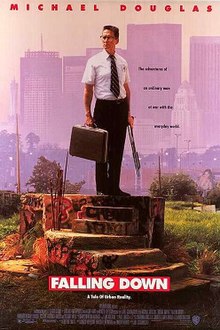 Theatrical release poster | |
| Directed by | Joel Schumacher |
| Written by | Ebbe Roe Smith |
| Produced past |
|
| Starring |
|
| Cinematography | Andrzej Bartkowiak |
| Edited by | Paul Hirsch |
| Music by | James Newton Howard |
| Production |
|
| Distributed by | Warner Bros. |
| Release dates |
|
| Running time | 113 minutes |
| State | United States |
| Language | English |
| Budget | $25 million[i] |
| Box office | $96 1000000[2] |
Falling Downward is a 1993 American activeness film[3] directed by Joel Schumacher, written by Ebbe Roe Smith and released by Warner Bros. in the United States on February 26, 1993.[4] The film stars Michael Douglas in the atomic number 82 role of William Foster, a divorced and unemployed erstwhile defense engineer. The film centers on Foster as he treks on foot across the city of Los Angeles, trying to achieve the house of his estranged ex-married woman in time for his daughter'southward birthday. Along the way, a series of encounters, both trivial and provocative, causes him to react with increasing violence and make sardonic observations on life, poverty, the economy, and commercialism. Robert Duvall co-stars as Martin Prendergast, an aging Los Angeles Police Section sergeant on the day of his retirement, who faces his own frustrations even as he tracks downward Foster.
Plot [edit]
William Foster is stuck in traffic on a hot day. After his air conditioning fails, he abandons his car and begins walking home across Los Angeles, carrying his briefcase.
At a convenience store, the Korean owner refuses to requite change for a telephone call. Foster begins ranting well-nigh the high prices. The owner grabs a baseball bat and demands Foster leave. Foster takes the bat and destroys much of the merchandise earlier leaving. Shortly thereafter, while resting on a hill, he is accosted by two hispanic gang members, who threaten him with a knife and need his briefcase. Foster attacks them with the bat and takes their knife.
The two gang members, now in a motorcar with ii friends, cruise the streets and detect Foster in a phone booth. They open burn, hitting several bystanders simply not Foster. The commuter loses control and crashes. Foster picks up a gun, shoots the i surviving gang fellow member in the leg, and and then leaves with their bag of weapons. Foster encounters a panhandler and gives him the briefcase, which only contains his lunch, which infuriates the man.
At a fast-food restaurant, Foster attempts to club breakfast, but they accept switched to the lunch menu. After an argument with the managing director, Foster pulls a gun and fires into the ceiling accidentally. After trying to reassure the frightened employees and customers, he orders luncheon, just is annoyed when the burger looks nothing like the one shown on the menu. He leaves, tries to phone call from a phone booth, and so shoots the booth to pieces afterward existence hassled by someone who was waiting to use the telephone. After Foster calls "domicile" again and states his intention to attend his daughter Adele's birthday political party, his ex-wife Beth notifies the police because she has a restraining gild and fears he might go vehement.
Sergeant Martin Prendergast, who is on his last day before retirement, insists on investigating the crimes. Interviews with the witnesses at each scene lead Prendergast to realize that the aforementioned person may be responsible. Foster'southward "D-FENS" vanity license plate proves to be an of import lead, because Prendergast remembers being in the aforementioned traffic jam equally Foster earlier that day. Prendergast and his partner, Detective Torres, visit Foster'due south mother, who is surprised to acquire that Foster lost his job. They realize Foster is heading toward his former family's home in Venice, California and blitz to intercept him.
Foster passes a depository financial institution where a black homo is protesting later being rejected for a loan application. The human being exchanges a glance with Foster and says, "Don't forget me," as he is escorted away by police. Foster stops at a armed forces surplus store to buy shoes. The possessor, a Nazi white supremacist, diverts Torres's attention when she comes in to ask questions. After Torres leaves, he offers Foster a rocket launcher and congratulates him for shooting "a bunch of niggers" at the Whammy Burger. When Foster expresses distaste for the store owner's racism, the man pulls a gun and attempts to plow him over to the police, merely Foster stabs him with the gang member's knife, then shoots him dead. He changes into regular army fatigues and boots, takes the rocket launcher, and leaves. He cuts through a golf game form where a golfer deliberately tries to hitting him with a ball. Foster shoots his golf cart, causing the golfer to accept a middle attack.
Foster encounters a road repair crew who are not working and accuses them of doing unnecessary repairs to justify their budget. He pulls out the rocket launcher but struggles to apply information technology, until a boy explains how it works. Foster accidentally fires the launcher, blowing upwardly the construction site. By the time Foster reaches Beth's business firm, she has already fled with Adele. He realizes that they may have gone to nearby Venice Pier, but Prendergast and Torres arrive earlier he can pursue them. Foster shoots Torres, injuring her, and flees with Prendergast in pursuit.
At the pier, Foster confronts his ex-married woman and daughter. Adele is happy to see him, just Beth is frightened. Prendergast arrives and acknowledges Foster's complaints about being ill-treated by society, but does not take that excuses his rampage. With Foster distracted, Beth throws his gun into the sea every bit Prendergast draws his revolver, insisting that Foster give himself up. With nothing left for him, Foster tricks Prendergast into shooting him dead. Having asserted himself, Prendergast decides to hold off retirement.
Cast [edit]
- Michael Douglas as William "D-Fens" Foster
- Robert Duvall as Sergeant Martin Prendergast
- Barbara Hershey as Elizabeth "Beth" Trevino
- Rachel Ticotin as Detective Sandra Torres
- Tuesday Weld as Amanda Prendergast
- Frederic Forrest as Nick
- Lois Smith as Foster's Mother
- Joey Hope Singer as Adele Foster-Trevino
- Michael Paul Chan as Mr. Lee
- Raymond J. Barry equally Captain Pecker Yardley
- D. W. Moffett every bit Detective Lydecker
- Steve Park as Detective Brian
- James Keane equally Detective Keene
- Marlo Thomas every bit KTLA Reporter
- Karina Arroyave as Angie
- Brent Hinkley equally Rick
- Dedee Pfeiffer equally Sheila Folsom
- Vondie Curtis-Hall as "Not Economically Viable" Human
- James Morrison equally Construction Sign Man by Coach Stop
Production [edit]
Evolution [edit]
Falling Downwards was being shot on locations in Lynwood, California, when the 1992 Los Angeles riots began. By April 30, the riots were sufficiently disruptive to force filming to cease early that mean solar day.[5] Film crews produced more footage within of Warner Bros. Studio, in Burbank, as the riots continued. Past May 4, when the crew intended to resume in Pasadena, initial requests to do so were denied, causing delays.[6] Filming wrapped in late June 1992.[7] Product designer Barbara Ling said, "We mapped this so that yous actually were going beyond [Los Angeles] from Silverish Lake downwards to mid-urban center to Koreatown."[8]
In an interview less than a week before Falling Down 's release, screenwriter Ebbe Roe Smith gave his estimation of what the movie was most. "To me, fifty-fifty though the movie deals with complicated urban issues, it really is just about ane basic thing: The primary grapheme represents the former power structure of the U.S. that has now become archaic, and hopelessly lost. For both of them, it's suit-or-die fourth dimension..."[9]
Casting [edit]
Foster's signature haircut was the idea of Joel Schumacher and the moving picture'south hairstylist, Lynda Gurasich. Douglas commented on how it helped him get into the grapheme of a veteran of the military or defense industry, "It gave me the feeling of the late '50s and the early on '60s, and somehow my character yous kinda have the feeling that he came from another time, or he wished or he hoped for another time when things made sense." Douglas would add together concerning the character, "There's a lot of people who are a paycheck abroad from being on the streets and beingness out of work who did everything right, they've been responsible, they tried hard, [and] they don't know what went wrong! We won the war, where's it all at?"[10]
Reception [edit]
Box role [edit]
The film grossed $96 million confronting a $25 meg budget. It took the peak spot at the U.s. box office in its get-go two weeks of release (Feb 26–28 and March 5–7, 1993). Falling Downward pushed the previous superlative picture, Groundhog Mean solar day, into the second place box-office spot for both those weeks.[11] It grossed $forty.9 one thousand thousand in the Us and Canada and $55.one million internationally.[12] [2]
Critical reception [edit]
Falling Down holds an blessing rating of 75% on Rotten Tomatoes based on 55 reviews, with an average rating of half-dozen.80/ten. The site's consensus states: "Falling Down 's popcorn-friendly accept on its circuitous themes proves disquieting—and ultimately plumbing fixtures for a bleakly entertaining picture of 1 man'southward angry break with reality."[13] However, the film as well has a weighted average score of 56 out of 100 on Metacritic based on 21 critics, indicating "mixed or average reviews".[xiv] [15] Audiences surveyed by CinemaScore gave the moving-picture show an average course of "B" on an A+ to F calibration.[16]
Contemporary [edit]
Contemporary reviews of Falling Down were generally mixed to positive.
Vincent Canby of The New York Times called it "the most interesting, all-out commercial American moving-picture show of the twelvemonth to appointment, and i that will function much like a Rorschach exam to betrayal the secrets of those who spotter it."[4] Philip Thomas of Empire magazine wrote in his review of the flick, "While the morality of D-Fens'due south methods are questionable, there's a resonance about his reaction to everyday annoyances, and Michael Douglas' hypnotic performance makes information technology memorable."[17] James Berardinelli wrote: "Falling Down is replete with gallows humor, near to the signal where it could be classified as a 'black comedy'."[18] John Truby calls the film "an anti-Odyssey story" virtually "the lie of the American Dream".[19] He adds, "I tin't think laughing so difficult in a film."[19] Kenneth Turan of the Los Angeles Times wrote that "Falling Downwards encourages a gloating sense that nosotros the long-suffering victims are finally getting our excellent revenge. The ultimate hollowness of that kind of triumph reflects the shallowness of a movie all too eager to serve it upwards."[xx]
Roger Ebert, who gave the film a positive review at the fourth dimension of its release, wrote:
Some will even discover information technology racist because the targets of the film'due south hero are African American, Latino, and Korean—with a few Whites thrown in for residuum. Both of these approaches correspond a facile reading of the film, which is actually about a great sadness, which turns into madness, and which can agonize anyone who is told, afterward many years of hard work, that he is unnecessary and irrelevant... What is fascinating well-nigh the Douglas character, as written and played, is the core of sadness in his soul. Aye, by the time we meet him, he has gone over the edge. Simply there is no exhilaration in his rampage, no release. He seems weary and confused, and in his actions he unconsciously follows scripts that he may take learned from the movies, or on the news, where other frustrated misfits vent their rage on innocent bystanders.[21]
The Washington Mail author Hal Hinson observed:
This guy is you, the movie suggests, and if not you exactly, and so perhaps the guy you're one or two bad breaks from becoming. At in one case or another, nosotros've all thought these thoughts, and so when this downtrodden, laid-off, teed-off L.A. defense force worker gets out of his auto on a sweltering twenty-four hours in the middle of rush hour and decides he's not going to take any more, it comes every bit no surprise", adding "as he did in Fatal Attraction and Wall Street, Douglas over again takes on the symbolic mantle of the Zeitgeist. But in Falling Downward, he and Schumacher desire to have their block and eat it also; they desire him to exist a hero and a villain, and it just won't piece of work.[22]
Peter Travers of Rolling Rock gave the motion-picture show four stars out of five, writing:
There's no denying the ability of the tale or of Douglas'southward riveting performance—his all-time and riskiest since Wall Street. Douglas neither demonizes nor canonizes this flawed grapheme. Marching across a violent urban landscape toward an illusory dwelling, this shattered Lowest is never less than real ... "I'thousand the bad guy?" he asks in disbelief. Douglas speaks the line with a searing poignancy that illuminates uncomfortable truths without excusing the grapheme. Schumacher could accept exploited those tabloid headlines most solid citizens going berserk. Instead, the timely, gripping Falling Down puts a human face on a common cold statistic then dares united states to expect away.[23]
Mick LaSalle said of the picture in the San Francisco Chronicle:
A few times every year, Hollywood makes a mistake, violates formula, and actually makes a great picture. Falling Down is 1 of the dandy mistakes of 1993, a pic too good and also original to win any Oscars, but 1 bound to exist remembered in years to come up as a true and ironic argument nearly life in our time.[24]
At the time of its release, Douglas'southward father, actor Kirk Douglas, declared, "He played it brilliantly. I think information technology is his best piece of work to engagement."[25] He also dedicated the film confronting critics who claimed that it glorifies lawbreaking: "Michael's character is non the 'hero' or 'newest urban icon'. He is the villain and the victim. Of course, we encounter many elements of our gild that contributed to his madness. Nosotros even compassion him. But the movie never condones his actions."[25]
Falling Down was released in theatres less than one yr after the 1992 Los Angeles riots, during which Korean Americans and their businesses were targeted past rioters. The Korean American Coalition[26] and Korean Grocers Association[27] protested the film for its handling of minorities, especially the Korean grocer. Warner Bros. Korea cancelled the release of Falling Down in S Korea post-obit cold-shoulder threats.[28] The outcry past the Grocers Clan led to Michael Douglas coming together with the organization'south members at the Warner Bros. Studio because they "were there and they were pissed. And so we had a chat and I told them, 'Look, I'm very sorry, merely there'due south a reason the screenwriter picked sure things to put in the film.'"[29] Unemployed defence force workers were also angered at their portrayal in the film.[26]
The character of D‑FENS was featured on magazine covers, including the March 29, 1993 issue[30] of Newsweek magazine, and reported upon equally an embodiment of the "angry white male" stereotype.[31]
After opinions [edit]
On the 25th anniversary of the film's release in 2017, film critic April Wolfe of LA Weekly wrote that it "remains ane of Hollywood's most overt yet morally complex depictions of the mod white-victimization narrative, one both adored and reviled by the extreme right". Wolfe said "Today, we might see D-Fens and the white supremacist every bit the infighting sides of the far right — i couches racism in coded words similar "thug," while the other wants an outright ethnic cleanse. Ultimately, what both want is to return to their idea of a purer America, unburdened by the concerns of minorities and women". Wolfe suggested that Rupert Murdoch would "proceed to bottle that fury and package it as patriotism" in creating Fox News.[32]
In 2012, Tasha Robinson of The A.V. Lodge was critical of the '90s motion picture "that well-nigh stands out for me from that era, because it's such a ham-handed, wrong-headed, self-congratulatory attempt to encapsulate its era'due south spirit". Robinson added, "the film treats near everyone around him [D-FENS] as worthless, and presents his violence equally the comedic payoff, turns information technology into a tone-deaf, cocky-pitying lament about the terrible persecution facing the oppressed majority in an era of political correctness and increasing multiculturalism." She finishes her short review with, "Information technology's a profoundly hateful motion picture disguised alternately (and erratically) as either tragedy or sense of humor."[33] An before 2008 review on the site was positive, saying, "Oestrus used as a metaphor for simmering rage is nothing new, but few films execute sweaty psychosis every bit well."[34]
Accolades [edit]
- 1993 Cannes Film Festival, Nominated for the Palme d'Or (Joel Schumacher)[35]
- 1994 Edgar Laurels, Won for All-time Motion Picture Screenplay (Ebbe Roe Smith)[36]
In other media [edit]
Falling Down has been the inspiration of musical artists such as Iron Maiden, Foo Fighters, Forepart Line Associates, and Eye Set on Man. The Atomic number 26 Maiden song "Man on the Edge" is a basic summary of Falling Down, beginning with describing the opening traffic jam, and ending with describing the birthday present Foster buys for his girl. The Foo Fighters' song "Walk" has a music video that is a recreation of scenes from Falling Down. The Front Line Assembly album Millennium contains several samples from various scenes from Falling Down.[37] The Heart Attack Human song "Out For Blood" was inspired by the acrimony and frustration weaved through Falling Down which weaves through the rest of their album False Claret.[ citation needed ]
In the video game Tony Hawk's American Wasteland, a graphic symbol resembling Foster recreates the rocket launcher scene in a cutscene, blowing up a structure site before walking abroad with a duffel bag.[38]
An episode of the animated series Duckman titled "A Room with a Bellevue" (episode six of season 3), is loosely based on the plot of Falling Downwards. Duckman has to pick up his new suit from the dry cleaner to be presentable on his children's birthday, simply huge traffic and the law are going to finish him.
Frank Grimes, a one-off character on The Simpsons episode "Homer's Enemy", is modeled after Foster, having the same flat-top haircut and white shirt and briefcase.[39]
The ring Slipknot sampled the famous "Freedom of Speech" clip in two songs - some earlier versions of "Gently", and "Interloper".[ citation needed ]
In the song "I'm in It", Kanye West references the motion picture when he raps "Time to take it too far now/Michael Douglas out the car at present".[40] [ better source needed ]
References [edit]
- ^ "Falling Down (1993)". IMDb. May 25, 1993. Retrieved June 23, 2020.
- ^ a b Klady, Leonard (January 3, 1994). "Int'l top 100 earn $8 bil". Diversity. p. one.
- ^ "Falling Down (1993)". Rotten Tomatoes.
- ^ a b Canby, Vincent (February 26, 1993). "Falling Downward (1993) Review/Film; Urban Horrors, All Besides Familiar". The New York Times.
- ^ "3 May 1992". Southern Illinoisan. p. xi. Retrieved October xi, 2016.
- ^ "Hollywood Pic Crews Run into Riot Delays". The Los Angeles Times. 1992-05-05. Retrieved 2016-10-11 .
- ^ "Surprise". Detroit Complimentary Printing. 23 Jun 1992. p. 25. Retrieved 2016-10-12 .
- ^ "Setting a Path Beyond L.A. With the Unhinged Antihero of 'Falling Down'". L.A. TACO. February 25, 2018. Retrieved 2018-03-05 .
- ^ Potato, Ryan (February 21, 1993). "MOVIES : 'Falling Downwards' Writer Has Seen the Futurity: It's L.A." Los Angeles Times. ISSN 0458-3035. Retrieved June 10, 2016.
- ^ Tibbits, John C. Falling Downwards: Conversations Well-nigh the Film. Academy of Kansas.
- ^ "Groundhog Day (1993)—Weekend Box Role Results". Box Function Mojo. Retrieved 2016-x-06 .
- ^ "Falling Downward (1993)". Box Office Mojo. May 25, 1993. Retrieved June 15, 2012.
- ^ "Falling Down". Retrieved March 23, 2022 – via www.rottentomatoes.com.
- ^ "Falling Down" – via www.metacritic.com.
- ^ "Metacritic score". IMDb.
- ^ "Cinemascore". Archived from the original on 2018-12-20.
- ^ "Empire Online – Falling Down Review".
- ^ "Reelviews Movie Reviews". Reelviews.net. 1993-02-26. Retrieved 2013-08-18 .
- ^ a b "Falling Downwardly". Truby.com.
- ^ "Everyman Can't Keep From 'Falling Downwards'". Newspapers.com. The Los Angeles Times. 1993-02-26. p. 80 (F5). Retrieved 2022-04-16 .
- ^ Ebert, Roger (Feb 26, 1993). "Falling Downward". RogerEbert.com. Ebert Digital LLC. Retrieved July 4, 2018.
- ^ Hinson, Hal (February 26, 1993). "Falling Down". The Washington Post . Retrieved 2014-04-23 .
- ^ Travers, Peter (Feb 26, 1993). "Falling Down". Rolling Stone. Archived from the original on Apr 23, 2014. Retrieved 2014-04-23 .
- ^ "Mick LaSalle's Profile". Metacritic.
- ^ a b "Kirk Douglas Defends Son". McCook Daily Gazette. March 23, 1993. Retrieved 2012-06-28 .
- ^ a b Appelo, Tim (March 12, 1993). "'Down' Beat—Up in arms over Falling Downwardly—Laid-off workers are offended past the Michael Douglas film". Amusement Weekly . Retrieved 2012-03-17 .
- ^ ""Falling Downwards" Under Fire". The Tennessean. 1993-03-03. Retrieved 2016-10-06 .
- ^ "'Falling Downwards' won't play Korea." Rocky Mountain News, March x, 1994.
- ^ "Michael Douglas on 8 of his greatest roles, from Gordon Gekko to Liberace". Retrieved 2016-ten-06 .
- ^ "White Male Paranoia". Newsweek. 1993-03-28. Retrieved 2017-04-12 .
- ^ Carl Scott Gutiérrez-Jones (2001). Critical race narratives. NYU Press. pp. 61–65. ISBN978-0-8147-3145-1.
- ^ Wolfe, Apr (2017-04-26). "Hey, White People: Michael Douglas Is the Villain, Not the Victim, in Falling Down". L.A. Weekly. Archived from the original on 2017-04-27. Retrieved 15 Feb 2021.
- ^ Staff, A.V. Club (2012-10-12). "Our nigh-hated movies of the '90s". Motion-picture show . Retrieved 2018-05-30 .
- ^ Staff. "It's non the rut, it'southward the intensity: 13 memorable films set during heat waves". Motion-picture show . Retrieved 2018-05-30 .
- ^ "Festival de Cannes: Falling Downward". festival-cannes.com. Archived from the original on 2009-ten-03. Retrieved 2009-08-18 .
- ^ "Category List – Best Motion Picture". The Edgars. Retrieved 2019-07-02 .
- ^ "Samples". Mindphaser . Retrieved June 13, 2021.
- ^ Perry, Douglass C. (2005-05-17). "E3 2005: Tony Militarist'south American Wasteland". IGN . Retrieved 2022-04-04 .
- ^ Weinstein, Josh (2006). The Simpsons season 8 DVD commentary for the episode "Homer'due south Enemy" (DVD). 20th Century Fox.
- ^ "Uh, Michael Douglas out the car now". Genius.
Farther reading [edit]
- Davies, Jude (2013-12-04). Falling Down. Macmillan International Higher Education. ISBN9781137363084.
- Frauley, Jon (2010). "Moral Transcendence and Symbolic Interaction in Falling Down". Criminology, Deviance, and the Silver Screen: The Fictional Reality and the Criminological Imagination. New York: Palgrave Macmillan. ISBN9780230115361.
External links [edit]
- Falling Downwardly at IMDb
- Falling Down at the TCM Motion-picture show Database
- Falling Down at AllMovie
- Falling Down at Rotten Tomatoes
- Falling Downward at Metacritic
- Falling Downward Trailer

Source: https://en.wikipedia.org/wiki/Falling_Down
Posted by: brunsonthadders1937.blogspot.com
0 Response to "Ein Ganz Normaler Tag 2019 Trailer"
Post a Comment