

How Many People Die From Lack Of Clean Water
Unsafe water is a leading take chances factor for death
Unsafe h2o sources are responsible for 1.2 1000000 deaths each year
Dangerous water is one of the earth's largest health and ecology problems – particularly for the poorest in the world.
The Global Brunt of Affliction is a major global written report on the causes and risk factors for expiry and disease published in the medical periodical The Lancet.1 These estimates of the annual number of deaths attributed to a broad range of take chances factors are shown hither. This chart is shown for the global full, but can exist explored for any state or region using the "alter country" toggle.
Lack of access to prophylactic water sources is a leading run a risk factor for infectious diseases, including cholera, diarrhoea, dysentery, hepatitis A, typhoid and polio.2 It also exacerbates malnutrition, and in item, childhood stunting. In the chart we run into that it ranks equally a very important risk factor for death globally.
According to the Global Brunt of Disease study 1.2 people died prematurely in 2022 equally a outcome of unsafe h2o. To put this into context: this was iii times the number of homicides in 2022; and equal to the number that died in road accidents globally.
The global distribution of deaths from dangerous water
In depression-income countries unsafe h2o sources business relationship for half-dozen% of deaths
An estimated 1.2 million people died every bit a consequence of dangerous water sources in 2022. This was 2.2% of global deaths.
In low-income countries, it accounts for half dozen% of deaths.
In the map here we see the share of almanac deaths attributed to unsafe water across the earth. In 2022 this ranged from a loftier of 14% in Republic of chad – around one-in-vii deaths – to less than 0.01% across most of Europe.
When nosotros compare the share of deaths attributed to unsafe water either over fourth dimension or betwixt countries, we are not only comparing the extent of h2o access, just its severity in the context of other adventure factors for death. Clean water'southward share does non only depend on how many dice prematurely from it, only what else people are dying from and how this is changing.
Expiry rates are much higher in low-income countries
Expiry rates from dangerous water sources give us an accurate comparison of differences in its mortality impacts between countries and over time. In contrast to the share of deaths that we studied before, expiry rates are not influenced by how other causes or risk factors for death are changing.
In this map we see death rates from unsafe water sources across the world. Death rates measure out the number of deaths per 100,000 people in a given country or region.
What becomes clear is the large differences in death rates between countries: rates are high in lower-income countries, particularly across Sub-Saharan Africa and Asia. Rates hither are oft greater than l deaths per 100,000 – in the Cardinal African Commonwealth and Chad this was over 100 per 100,000.
Compare this with expiry rates across high-income countries: across Europe rates are beneath 0.1 deaths per 100,000. That's a greater than 1000-fold difference.
The outcome of dangerous sanitation is therefore one which is largely limited to low and lower-middle income countries.
We run across this human relationship clearly when we plot death rates versus income, as shownhither. There is a potent negative relationship: expiry rates decline as countries become richer.
1-in-four people do non have admission to condom drinking water
SDG Target 6.1 is to : "reach universal and equitable access to rubber and affordable drinking water for all" by 2030.
Where are we today? In 2022, nearly three-quarters (74%) of the world population had access to a safely managed water source. One-in-4 people do non have access to rubber drinking water.
In the chart nosotros see the breakdown of drinking water access globally, and across regions and income groups. We see that in countries at the everyman incomes, less than ane-third of the population accept prophylactic water. Near live in Sub-Saharan Africa.
Are nosotros making progress? The world has fabricated progress in the last five years. Unfortunately, this has been very irksome. In 2022 (at the start of the SDGs) only 70% of the global population had safety drinking h2o. That means nosotros've seen an increase of four percentage points over 5 years.
This is obviously far likewise slow to accomplish universal access by 2030. If progress continues at these rates, we would only reach 82% by 2030. If we're to meet our target we need to come across rates of progress more triple (increase three.2-fold) for the coming decade.3
Access to rubber drinking water by country
In the map shown nosotros see the share of people beyond the world that accept access to safe drinking water.
How many people do not have admission to prophylactic drinking water?
In the map shown we see the number of people across the world that do not have access to safety drinking water.
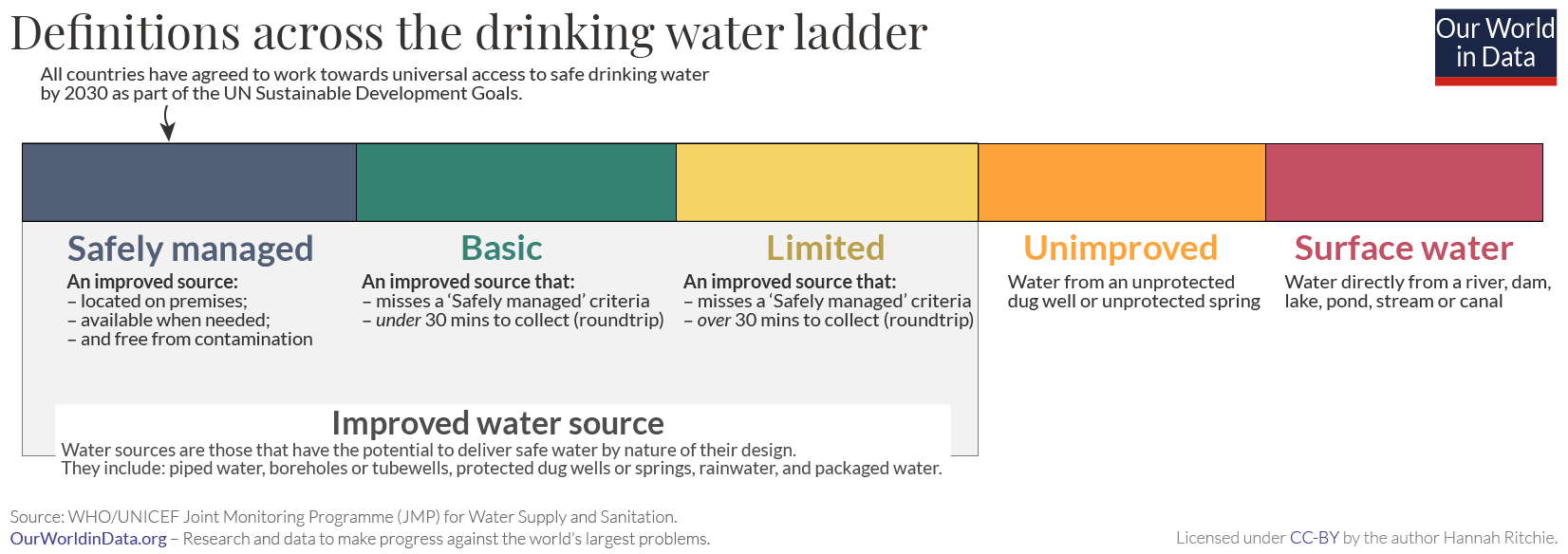
The definition of an improved drinking water source includes "piped water on premises (piped household water connection located inside the user'southward abode, plot or yard), and other improved drinking water sources (public taps or standpipes, tube wells or boreholes, protected dug wells, protected springs, and rainwater collection)." Notation that admission to drinking water from an improved source does not ensure that the water is condom or adequate, as these characteristics are non tested at the time of survey. But improved drinking water technologies are more than likely than those characterized as unimproved to provide safe drinking water and to prevent contact with human excreta.
In 2022, 6% of the world population did non take access to an improved water source.
In the map shown we see the share of people across the world that exercise not have admission to improved water sources.
How many people don't accept access to an improved water source?
In the map shown we see the number of people across the globe that practise non have access to an improved water source.
Access to improved water sources increases with income
The visualisation shows the relationship between admission to improved water sources versus gdp (Gross domestic product) per capita. We see that there is a general link between income and freshwater access.
Typically virtually countries with greater than 90% of households with improved h2o have an average GDP per capita of more than $10,000-xv,000. Those at lower incomes tend to take a larger share of the population without access. However, there are some notable exceptions: for case, more than half of Equatorial guinea's population lacks admission to improved water despite having an GDP per capita higher up $27,000. In this case, the country'south wealth is highly full-bodied; the hateful Gdp per capita is therefore far from the median Gross domestic product (i.eastward. there are high levels of inequality). Republic of equatorial guinea is 1 of the few remaining autocracies in the African continent. Its politics and governance therefore has a much stronger influence than boilerplate income.
Although income is an important determinant, the range of levels of access which occur beyond countries of similar prosperity further support the proffer that in that location are other important governance and infrastructural factors which contribute. For example, Republic of malaŵi has achieved a 90% admission rate despite having a Gross domestic product per capita just over $1,000. Mozambique which has a like income levels has but over 50% access.
Rural households often lag behind on h2o access
In addition to the big inequalities in water admission between countries, in that location are can also be large differences within country. In the charts nosotros have plotted the share of the urban versus rural population with access to improved h2o sources and safely managed drinking water, respectively. Here nosotros have also shown a line of parity; is a country lies along this line and so admission in rural and urban areas is equal.
Since well-nigh all points lie to a higher place this line, with very few exceptions — notably Palestine — access to improved water sources is greater in urban areas relative to rural populations. This may be partly attributed to an income outcome; urbanization is a tendency strongly related to economic growth.four
The infrastructural challenges of developing municipal water networks in rural areas is also likely to play an important role in lower access levels relative to urbanised populations.
Definitions
Improved h2o source: "An improved drinking water source includes piped water on premises (piped household water connection located within the user's home, plot or g), and other improved drinking h2o sources (public taps or standpipes, tube wells or boreholes, protected dug wells, protected springs, and rainwater drove)."
Access to drinking water from an improved source does not ensure that the h2o is safe or adequate, equally these characteristics are non tested at the time of survey. Only improved drinking water technologies are more likely than those characterized every bit unimproved to provide safe drinking water and to forestall contact with human being excreta. While data on access to an improved h2o source is widely used, it is extremely subjective, and such terms as safe, improved, acceptable, and reasonable may have different meanings in different countries despite official WHO definitions. Fifty-fifty in high-income countries treated h2o may not e'er be safe to potable. Access to an improved h2o source is equated with connection to a supply arrangement; it does not have into business relationship variations in the quality and price (broadly defined) of the service." 5
Safely managed drinking water: "Safely managed drinking water" is defined equally an "Improved source located on bounds, available when needed, and free from microbiological and priority chemical contagion."
'Basic' drinking water source: an "Improved source within 30 minutes round trip collection fourth dimension."
'Express' drinking water source: "Improved source over xxx minutes round trip drove time."
'Unimproved' drinking water source: "Unimproved source that does not protect against contamination."
'No service': access to surface water only.
Explore more of our piece of work on Clean Water and Sanitation

Source: https://ourworldindata.org/water-access#:~:text=Water%20and%20Sanitation-,Summary,access%20to%20safe%20drinking%20water.
Posted by: brunsonthadders1937.blogspot.com
0 Response to "How Many People Die From Lack Of Clean Water"
Post a Comment